Choosing the right sound panels for walls can change how a room feels, sounds, and functions. Echoes often hide in plain sight, bouncing from glass, plaster, and bare floors. A conversation may seem unclear, while music loses detail near the corners. The right panel selection begins with the room’s purpose, dimensions, and existing surfaces. A home office needs speech clarity. A recording room demands more controlled reflection. A busy restaurant may require durable materials and easy cleaning.
This guide shares ten practical tips based on acoustic principles, product specifications, and real installation concerns. You will learn how to compare absorption ratings, panel thickness, fabric, placement, and mounting methods. Look for trustworthy manufacturer data, including noise reduction coefficients and fire-safety information. However, ratings do not tell the whole story. A panel that performs well in a laboratory may disappoint when poorly spaced or placed on the wrong wall. Small details matter. Even a two-inch air gap can improve absorption at certain frequencies.
Experience also teaches a less comfortable lesson: more panels are not always better. An over-treated room can feel unnaturally dull, like speaking inside a padded box. I once focused too heavily on reducing echo and overlooked visual balance. The room sounded controlled but felt cold. That mistake is worth remembering. Effective acoustic design combines measurable performance with practical use, reliable materials, and a finish that people can live with.
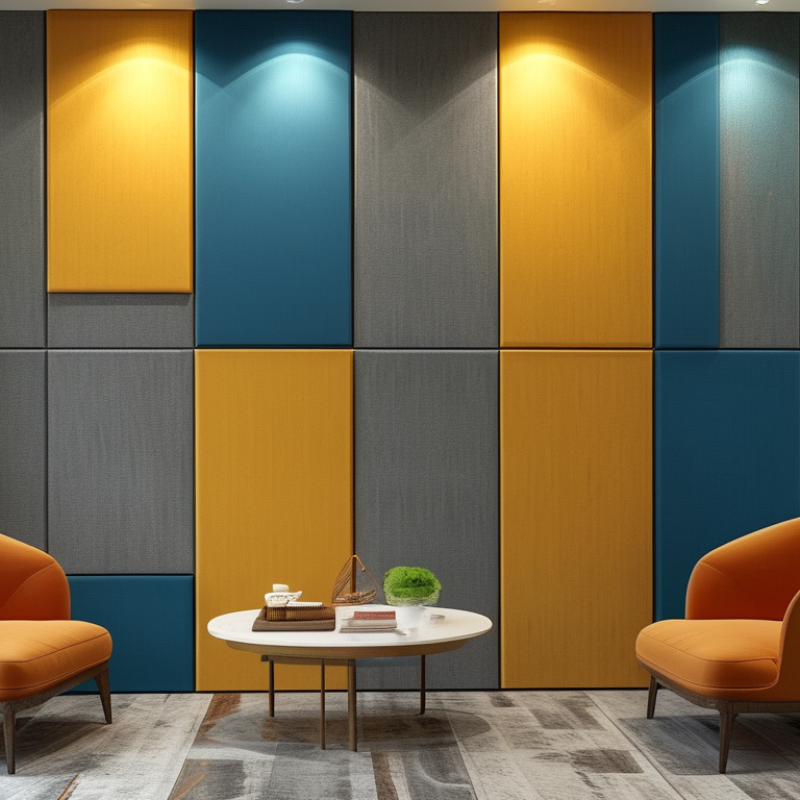
10 Tips for Choosing Sound Panels for Walls
Define the acoustic goal before comparing panel finishes. The Noise Reduction Coefficient, or NRC, ranges from 0 to 1. Under ASTM C423, it averages absorption at 250, 500, 1000, and 2000 Hz. An NRC of 0.80 suggests strong average absorption, not universal performance. Low-frequency noise may still remain.
Tip: Set a reverberation-time target, not only an NRC target. ISO 3382-2 defines methods for measuring room reverberation. For learning spaces, ANSI/ASA S12.60 recommends an unoccupied RT of 0.60 seconds or less in smaller classrooms. Offices may need different targets, depending on speech, ceiling height, occupancy, and background noise. Treat these figures as design guides, not automatic guarantees.
Tip: Review the full test report. Ask for absorption coefficients by frequency, mounting conditions, and room calculations. A wall panel rated NRC 0.95 can still perform poorly when coverage is sparse. In practice, covering around 15–25% of reflective wall area often changes speech clarity, but the correct percentage depends on room volume and surfaces. That shortcut is imperfect. Furniture, people, doors, and glazing also alter RT. Measure the existing room when possible, then compare the result with the target using calibrated equipment and a qualified acoustics professional.
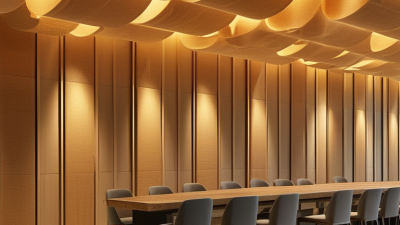
When choosing sound panels for walls, match their thickness to the frequencies you want to control. Thin panels usually absorb mid and high frequencies, such as speech, cymbals, and keyboard clicks. Low frequencies are different. They have longer wavelengths and need more material, air space, or both.
Tip: Use thicker panels for bass control.
In practical rooms, panels around 25–50 millimeters thick can reduce reflections and improve vocal clarity. However, they rarely solve serious bass problems alone. For lower frequencies, consider deeper absorbers, corner traps, or panels mounted with a clear air gap. A 100-millimeter panel with a 100-millimeter gap can absorb more effectively than the same panel placed directly against the wall. Placement matters greatly. Corners and wall-ceiling junctions often reveal strong low-frequency buildup.
Tip: Do not judge bass by thickness alone.
Panel density, airflow resistance, room size, and installation position also affect performance. I once treated a small listening room with attractive thin panels, but the bass remained uneven. The room sounded quieter, not balanced. That mistake taught me to measure before buying. Use frequency sweeps, decay measurements, or professional acoustic testing when possible. Manufacturer data can help, but real rooms behave differently. A panel rated for broad absorption may still perform weakly below 100 Hz. Leave enough space for doors, outlets, and ventilation. Good acoustic design should improve the room without creating new practical problems.
10 Tips for Choosing Sound Panels for Walls
Evaluate Coverage and Placement Using Sabine’s RT60 Equation
Sound panels should solve a measured problem, not decorate an empty wall. Sabine’s equation is RT60 = 0.161V/A. Here, V represents room volume, while A represents total absorption. Measure the room before buying panels. A 60-square-metre room with hard floors, glass, and plaster usually needs more absorption than a furnished office. Start with a clap test, then confirm results using an acoustic measurement app or calibrated meter. It is not perfect, but it reveals obvious echoes.
Use ten practical checks: identify the loudest reflection points, calculate ceiling height, note existing furniture, and estimate panel coverage. Choose panels with published absorption coefficients. Test data should follow ISO 354, while room reverberation measurements should follow ISO 3382. These standards improve comparison between products. For example, ANSI/ASA S12.60 recommends reverberation times around 0.6 seconds for many smaller classrooms. Your room may need a different target.
Placement matters more than random coverage. Install panels at ear height near first-reflection points, then add ceiling treatment when voices remain harsh. Leave some wall area untreated for balanced liveliness. Too much absorption can make speech feel unnaturally dry. I have seen attractive installations fail because they covered rear walls but ignored a reflective ceiling. Recheck RT60 after installation. Furniture, curtains, and occupancy can change the result. The calculation is useful, but real rooms remain imperfect.
Estimated reverberation time in a 150 m³ room before and after installing 20 m² of acoustic wall panels. RT60 is calculated with Sabine’s equation: RT60 = 0.161 × Room Volume ÷ Total Absorption.
The panels provide greater absorption at mid and high frequencies, reducing reverberation most effectively from 500 Hz upward. Compare the treated RT60 values with the target line when deciding panel coverage and placement.
Choosing sound panels for walls requires more than checking acoustic absorption. ASTM E84 measures flame-spread index and smoke-developed index under controlled conditions. Class A products show a flame-spread index of 0–25. Class B covers 26–75, while Class C covers 76–200. Each class generally requires a smoke-developed index of 450 or less.
Check the actual test report.
A certificate should match the panel’s thickness, facing, adhesive, and installation method. Changing the fabric or adding an untreated backing can affect performance. ASTM E84 is not a full-room fire simulation. It cannot predict every condition behind a wall panel. This limitation deserves attention. A common specification mistake is treating “Class A” as complete fire protection. It is not.
NFPA’s 2023 Fire Loss in the United States report estimated about 1.39 million fires and 3,670 civilian fire deaths nationwide. These figures reinforce why surface materials deserve careful review. ICC code provisions and local authorities may also require specific ratings for public, commercial, or exit-area installations. Ask for the complete laboratory report, not only a sales sheet. Verify the test date, specimen description, mounting method, and listed indices. Look for consistent documentation across batches. Small details matter. A low-cost panel with unclear testing may create expensive redesign work later.
| Tip | Selection Dimension | What to Check | Useful Data or Benchmark | Safety and Durability Consideration | Documentation to Request |
|---|---|---|---|---|---|
| 1 | Acoustic objective | Decide whether the main goal is reducing reverberation inside the room, improving speech clarity, or limiting sound transfer through the wall. | Wall-mounted absorptive panels primarily reduce reflected sound and room reverberation; they do not normally provide significant sound isolation between rooms. | Choose the product according to the room function rather than relying on appearance alone. | Acoustic test report identifying the test method, mounting condition, panel size, and measured absorption results. |
| 2 | Noise Reduction Coefficient (NRC) | Compare the declared NRC only when the tested thickness, air gap, mounting method, and panel size are similar to the planned installation. | NRC is a rounded average of sound-absorption coefficients at 250, 500, 1,000, and 2,000 Hz. Typical fabric-wrapped absorptive panels may be approximately NRC 0.50–0.95, depending on construction and installation. | A higher NRC generally indicates greater mid-frequency absorption, but it is not a fire rating or a sound-transmission rating. | Independent laboratory report with frequency-by-frequency absorption coefficients and the calculated NRC. |
| 3 | Panel thickness and air gap | Check the panel thickness and whether it will be installed directly on the wall or with a defined air space. | Common wall-panel thicknesses include about 25–100 mm. Thicker panels and an air gap can improve low- and mid-frequency absorption, subject to the test configuration. | Do not use absorption results from a thick, spaced installation to represent a thin, directly mounted panel. | Product specification sheet and test configuration showing thickness, mounting type, and air-space depth. |
| 4 | ASTM E84 flame-spread classification | Verify the flame-spread index (FSI) and smoke-developed index (SDI) from an ASTM E84 test report. |
Class A: FSI 0–25 Class B: FSI 26–75 Class C: FSI 76–200 ASTM E84 commonly reports SDI on a 0–450 scale; the applicable code or project specification determines the acceptable limit. |
Class A has the lowest flame-spread range among these classifications. ASTM E84 results do not describe every fire scenario and do not replace project-specific code review. | Complete ASTM E84 report stating the tested assembly, specimen thickness, substrate, conditioning, FSI, SDI, and laboratory details. |
| 5 | Core and facing materials | Review the composition of the acoustic core, outer fabric, adhesive, backing, and any edge treatment. | Mineral fiber, fiberglass, recycled polyester, wood-fiber, and perforated-panel constructions can have different absorption, fire, moisture, and impact characteristics. | The fire behavior of the complete finished panel may differ from that of an individual core or fabric component. | Full bill of materials, safety data sheets where applicable, and test reports for the finished panel assembly. |
| 6 | Moisture and environmental resistance | Confirm whether the panels are intended for dry interior areas, humid spaces, or locations exposed to occasional cleaning. | Many absorptive panels are intended for controlled interior conditions and should not be installed where they may become saturated or continuously exposed to condensation. | Moisture can cause staining, odor, loss of dimensional stability, adhesive failure, or reduced acoustic performance. | Installation limitations, humidity guidance, cleaning instructions, and any moisture or mold-resistance test data. |
| 7 | Mechanical durability | Evaluate resistance to impact, abrasion, edge damage, sagging, and repeated handling. | Higher-density facings, reinforced edges, and robust mounting systems are generally better suited to corridors, classrooms, public areas, and high-traffic rooms. | A fire classification alone does not confirm resistance to impact, compression, abrasion, or long-term deformation. | Durability test results, care instructions, panel density, edge details, and warranty terms without relying on brand claims alone. |
| 8 | Attachment and wall compatibility | Check the panel weight, mounting hardware, wall construction, and required clearances from electrical or building services. | Installation may use mechanical clips, Z-bars, cleats, tracks, adhesive, or a combination. The fastener type must match the wall substrate and expected load. | Secure attachment helps prevent falling panels and preserves the tested installation condition where the fire report specifies a particular mounting arrangement. | Installation drawings, permitted substrates, fastener requirements, panel weight, and maintenance access details. |
| 9 | Cleaning and maintenance | Determine whether the facing can be vacuumed, spot-cleaned, removed, or replaced without damaging the acoustic core. | Routine low-moisture cleaning is often preferable for porous absorptive surfaces. Strong solvents, excessive water, and aggressive brushing may damage the facing or adhesive. | Visible damage, contamination, or delamination can reduce service life and may alter the performance of the installed assembly. | Written cleaning procedure, replacement-part information, stain limitations, and recommended inspection intervals. |
| 10 | Verify the complete tested assembly | Match the proposed panel, facing, adhesive, backing, thickness, substrate, and installation method to the tested configuration. | Fire and acoustic results are configuration-specific. A report for one material, thickness, or mounting method should not automatically be applied to another. | Obtain approval from the authority having jurisdiction or project fire consultant when the installation is subject to a building-code requirement. | Current third-party ASTM E84 report, acoustic report, installation instructions, technical data sheet, and project-specific compliance statement. |